Showing posts with label casters & wheels. Show all posts

Friday, March 6, 2015

Stem Casters, Common Styles & Applications


There are several different styles of stem casters, from industrial applications to food service carts and dollies to furniture and displays. The problem with these casters and wheels is that there are many options and sizes to choose from and it can at times be confusing. Most stemmed casters are also available in stainless steel.
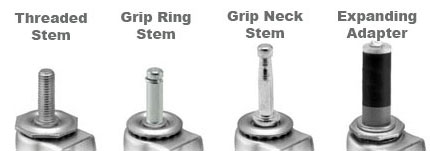
threaded stems, grip ring stem, grip neck stem, expandable adapters

Pictured are the styles of stems that are most common.


Threaded Stem Casters are the most complex due the size and thread pitch variations available.
These are very common but may need some expertise in determining the correct size.
See measuring a caster on the BuyCasters.com website. These casters are used on displays, furniture, carts and medical equipment, etc. and is usually used in light duty or medium duty applications.

Grip Ring Stems are used on most new office chairs and furniture, seen often on the hooded twin wheel casters for chairs. There are several other applications like Metro Brand Wire shelving, casters for Rubbermaid Mop Buckets and many more. They are designed to fit into a tube or socket and the C-Clip when compressed applies pressure to the tube. Very easy to replace and install.

Expandable Adapter casters are commonly used larger round and sometimes square tubing, these caster stems will expand, within a size range, by tightening the collar on the base of the stem and apply pressure to the walls of the tubing. These can sometimes be difficult to install and a wrench is usually required. Often used in Medium duty industrial and custom applications.

Grip Neck Stems are not used that often anymore, these stemmed casters are mostly seen on older wooden furniture. This stem needs a socket that is hammered into the legs of the furniture and the caster and wheel snaps into the socket.

If you have any questions about your caster and wheel needs please call 1-855-943-3511 or stop by www.buycasters.com

Friday, January 16, 2015

Casters for high temperatute applications

4"x 2"  High Temp Phenolic Wheel 1/2" Plain Bore
High Temp Phenolic wheel


A common problem for industries that use high temperature applications , (such as industrial, autoclaves, bakeries, paint booths, foundries, etc.), is what caster and wheel to use that won't be affected by the extreme heat.
We can offer a few solutions to the problem. First off a few questions...


What type of heat is it, humid or dry?  
Medium Duty 6"x 2"" Swivel Caster High Temp Nylon Wheel
Glass Filled Nylon Swivel Caster
For dry heat we recommend either steel or a high temperature phenolic wheel with a plain bore or roller bearing with high temp grease installed. The Phenolic wheel will offer similar capacities to the steel but won't spark and offer a little better floor protection.
For wet or humid heat applications a high temp glass filled nylon wheel will be perfect. You can use steel wheels but they may rust over time.


10"x 3" Ductile Steel Wheel Red Roller Bearing
Ductile Steel
 How long will the caster be in the heat?
High temperature casters can be in extreme heat but the but the duration of the heat can lessen the overall temperature handling of the caster, wheel and bearings. For extended extremely high temps and periods of time, a steel wheel with a plain bore will be necessary, there may be some engineering involved to allow for expansion around the axle in harsher circumstances.

How hot is it?
All of our products will have heat tolerances listed in the technical specs.

If you have any questions about your application please visit our website or call one of our knowledgeable staff at 1-855-943-3511.

Wednesday, April 16, 2014

Stainless Steel vs. Tarditional Steel Casters


stainless steel caster, stainless rigid caster, swivel caster, stem caster

In most cases a traditional steel caster is sufficient for strength, durability and corrosion resistance. 
These casters are zinc coated to help with rust but are not rust proof. However there are certain applications that require more protection from the environment in which they are used.

Some examples are if the swivel, rigid or stem mounted casters and wheels are used on carts or dollies outdoors in rain or snow. Other like the food industry or medical equipment in hospitals and laboratories that require steam cleaning and wash downs on a regular basis.  Some manufacturing and processing plants may use heavy duty carts that are subject to corrosive chemicals and cleaning agents, or in marine In these cases a stainless steel caster would be ideal, While stainless steel is more expensive than traditional steel the life span will be greatly increased in those situations and will save you money and time down the road by replacing them less, it will also increase safety, by having a properly rolling cart or equipment and have less chance of operational failure.

Buy Casters' stainless steel casters are made from the highest quality materials, 304 Stainless steel coupled with a nylon, polyurethane, polyolefin or rubber wheel, with a stainless bearing and axle the caster will be virtually impervious to corrosion.

Visit buycasters.com or call us at 1-855-WHEEL11 (943-3511) for more information on our line of stainless steel casters. A experienced sales professional will be happy to help you!

Tuesday, January 14, 2014

How to Choose Casters & Wheels

Moving furniture and heavy objects, from cabinets to industrial supplies, can be a heavy burden without wheels or casters. Casters include bearings, casings and wheels attached to a fastener to allow movement of heavy objects across a set distance. Whether you’re in need of casters for your business or your home, choosing casters takes the consideration of several factors, from possible weight loads to everyday versatility.
How to Choose Casters & Wheels

Here are some important things to remember when choosing casters:
  • Weight or Load Capacity - Before you decide on any caster based on material, diameter or attachment point, you have to determine the weight of what you’re trying to move. Each caster holds a maximum load capacity and this includes not only the object that you’re trying to move, but any cart or equipment weight that will also be the burden of the caster. Once you know the total weight of your load, you’ll be able to do divide that by the number of casters and wheels you’re using to find out the load capacity per wheel. Add more casters to heavy pieces to distribute the weight evenly and safely. Casters and wheels can fail and possibly injure you if not analyzed correctly for weight loads. Even when analyzed for proper load capacity, you’ll have to be cautious not to overload your casters. Try to move your load across an even surface at a steady, slow pace. 
  • Attachment - Two attachment strategies are available from most caster manufacturers. One type is better for movement whereas the other is better for larger, stable objects. 
    • Post/Stem casters use a long peg that fits directly into a machined orifice in the piece. A 2-inch chrome/gray rubber stem caster, for example, affixes to the object being moved to create a locking connection point. As you move around, the stem remains stable within the construction. 
    • Plate casters use screws to attach the fastener to the object's base. 
  • Wheel Type - Choose caster and wheel materials that match your strength and durability needs. As a cost saving tip, increasing the height and width of a caster and wheel will increase your load as long as you’re keeping your wheel materials consistent. Moving to a larger 10”x2” phenolic wheel from a smaller phenolic wheel will increase capacity, but moving to a 10”x2” Polyurethane wheel from a smaller phenolic wheel will not. 
    • Plastic is an inexpensive choice for lightweight applications since it is a softer material. For example, rolling a lightweight cart across a warehouse does not require a strong caster material. 
    • Select all steel wheels for heavy duty needs, such as moving heavy cargo loads on a cart. Phenolic wheels are also a stronger compound that may be beneficial in heavy duty moves. 
    • Office applications, where you need to protect the flooring from scuffs, require polyurethane or rubber casters. These soft materials keep the floor shining brightly, but they can’t handle the same heavy load capacity as a steel or phenolic wheel. 
  • Surfaces – In general, the larger the wheel diameter of your caster, the easier it roll across any surface. Anti-friction bearings will also help improve the smoothness of your ride. Of course, there are many different types of wheels and caster materials that are specially designed. 
    • If you have a slick floor surface, choose casters with specialized teeth. Typically applied to hard rubber materials, these locking teeth hold the wheels in place when you activate their mechanism. 
    • Wheels with soft rubber treads will help protect certain floors like softer tiles or hardwood floors commonly found in homes. 
    • If you need to increase load capacity across a softer floor, choose a Polyurethane tread. 
    • Regardless of your surface and wheel type, if you’re repetitive moving your load across the same path and surface, you will eventually see wear on the surface.
  • Direction - Some of the objects you move need to be moved in a basic straight direction, including food carts. Other applications, such as electronic mobile cabinets, require precision movement with 360-degree casters. Swivel casters allow you to move the in almost any direction instantaneously. A 2-inch black/black poly stem caster is an elegant-looking wheel that blends in with black electronic cabinets for a professional appearance. 
  • Specialty Casters - You may have certain caster needs that are outside generic contours. For medical industries, look for anti-bacterial wheels to prevent germ spread throughout a building, such as on crash carts. Shock absorbent casters are also available for sensitive electronics, including medical instruments. 
Casters are built to move items large and small. Consider your object’s specifications and select wheels that fit the indoor space. From elegant to industrial designs, casters are meant to make life easier when it comes to transporting items. Still need help finding the casters and wheels that are right for you? Contact Buycasters at info@buycasters.com or visit our resource page on choosing casters.